

Initially, people stitched animal hides into tubular structures to meet the needs of production and labor. After a considerable period, in the late 17th century, the Dutch Van der Heyden brothers produced longitudinally stitched canvas hoses, which were widely adopted for firefighting at the time. Later, with the emergence of rubber on the international market and the development of vulcanization technology, rubber hoses-as well as rubber hoses armored with wire, hemp rope, or other fabrics-came into existence. However, rubber hoses were unsuitable for transporting certain engineering media, such as high-temperature fluids (steam, hot air), cryogenic fluids (liquid hydrogen, oxygen, helium), or corrosive substances (gasoline, kerosene, acids, alkalis). Their safety and reliability were particularly difficult to guarantee under high-temperature conditions.
Consequently, attention shifted toward metal tubing; by altering the geometry of the metal tube to create corrugations on its inner and outer surfaces, the tube could achieve the flexibility of a rubber hose while also offering resistance to high and low temperatures, aging, and corrosion. Thus, the metal bellows-the core component of the metal hose-was born.
In 1855, Germany published the first patent for bellows manufacturing, utilizing principles derived from existing jewelry-making techniques. Thirty years later, the Frenchman E. Levavasseur and the German H. Witzenmann collaborated to develop a new type of metal bellows, securing patents in both France and Germany in August 1885. These were spiral bellows formed by winding an S-shaped metal strip on specialized equipment; rubber strips, cotton fabric, or asbestos rope were used to pack the interlocking seams between adjacent coils, ensuring a seal for the bellows' internal cavity.
In 1894, the structure of these bellows was improved: two metal strips were wound in opposite directions at different diameters. This configuration allowed the metal strips to counterbalance each other under load, thereby overcoming the problem of the bellows spontaneously unwinding. In 1929, a major technological breakthrough occurred in bellows design: the complete resolution of the sealing failure caused by uneven deformation of the grooves-which previously housed rubber strips or asbestos ropes-during bending. This innovation opened up vast prospects for the development of bellows. Integral bellows were subsequently manufactured from steel and copper-zinc alloys (using either seamless or welded tubing); these rely on the elastic deformation of the corrugated sidewalls to maintain compressibility or extensibility while ensuring a reliable seal.
From the 1950s onwards, the development of double-walled, triple-walled, and multi-walled bellows-particularly those made of ultra-thin-walled stainless steel-accelerated rapidly. To meet diverse operational requirements, various manufacturing techniques were employed, including welding, electroforming, machining, hydraulic forming, and mechanical spinning. Nominal diameters range from a minimum of 2 mm to a maximum of 400–500 mm, with giant bellows reaching diameters of up to 10 meters. The number of corrugations varies from as few as one or two to continuous sequences numbering in the hundreds, thousands, or even tens of thousands.
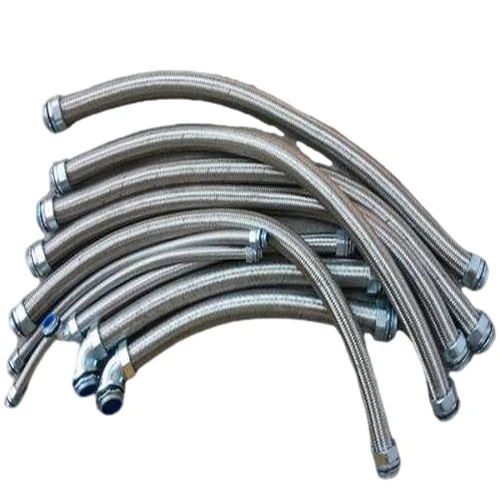
Given the critical role of bellows as the core component of metal hoses, the evolution of metal bellows effectively mirrors the evolution of metal hoses. Subsequent innovations-such as coating the outer surface with materials like rubber, plastic, or nylon; adding protective braiding made of metal wire or strip; and incorporating various types of end fittings-have led to the creation of diverse metal hose configurations tailored to a wide range of operating conditions.